
This guide is for readers of legal drinking age (21 and older in the United States). It is about glassware and other accessories, not about drinking more, and it does not sell or recommend bottles of alcohol. If you do not drink, you do not need to start because of anything written here. Do not drink and drive, and do not drink during pregnancy. Alcohol is not a health product.
A boxed set of glasses, or a decanter with two tumblers, is one of the easier whiskey-adjacent gifts, because it does not require you to guess a bottle. It can still go wrong: a leaded or unmarked decanter, a shape the person will never use, a set that cannot be returned, or a present that feels like a prompt to drink more. This is a buyer’s guide to accessory gift sets, not a list of alcohol to buy. For a wider gift conversation that also covers books and leaving room to decline, see how to give whiskey as a gift.
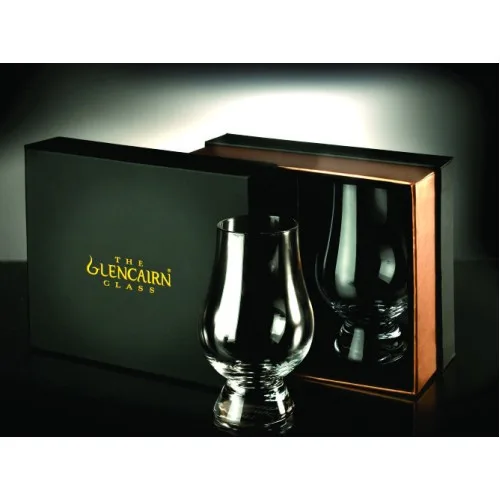
Start with the person, not the box
Ask, quietly, whether they already have a glass they like. Someone who noses new bottles may want a set of tulip tasting glasses. Someone who only ever uses a big ice cube may want two sturdy rocks glasses and no decanter. Someone who does not drink should not be given a bar set “to get them started.” A water jug, a book, or a different hobby gift is the kinder fork in the road.
If you do not know their glass size or brand, a returnable set from a maker with a clear official material label — preferably lead-free crystal or glass — is safer than a bargain unmarked “crystal” bundle. See lead crystal vs lead-free vs glass and whiskey glassware.
Sets of four tulips make sense for a small tasting at home. Sets of two are enough for a household of two. A flight tray with small glasses is a specialist gift; only buy it if they actually host side-by-side tastings, which we describe in hosting a small tasting.
When the decanter belongs in the box — and when it does not
A decanter is a serving piece. It is not improved storage, and it is a poor gift if the person has no shelf space, no interest, or an unknown leaded vessel in the set. If you include a decanter, choose a current, labeled lead-free or glass piece with a stopper that actually fits, and include the honest use case: pour for an evening, empty it, wash it. See how to use a whiskey decanter.
Skip the decanter if the set is already heavy, if the glasses are the real present, or if you cannot confirm the material. A good pair of glasses plus a care note is a complete gift.
Watch for kits that pad the box with extras nobody asked for: cheap stones, a random funnel, a flask of unknown quality. Those can be fine if they are well made and returnable; they are not a reason to pay more. For flasks and travel glasses as a standalone topic, see flasks and travel tasting glasses.
Presentation, returns, and tone
Leave the receipt or a gift receipt in an envelope. Prefer retailers with a clear return window, especially around holidays. Do not wrap a set so aggressively that the first chip happens at the unwrapping. If you ship it, pack it as if it were a move, not a soft sweater; see how to pack and move crystal.
The card should not joke that the person “needs a drink” or that the set is for drinking more. It can say you thought a pair of glasses might be useful if they already enjoy whiskey. If they do not, they should feel free to return it or re-gift the glasses as water glasses — a perfectly respectable use.
A tasting journal or a guidebook can sit beside a glass set without being a bottle. Our accessory cards include those kinds of add-ons, not alcohol. If you are also considering tools for a measured serve, see jiggers, pour spouts, and measured serves.
Researched current glasses and decanters in our 2026 list are a practical shortlist. Confirm the official set contents and material before you check out; a stock photo can hide a smaller glass or a different item.
FAQ
Is a monogrammed glass a good idea? Only if you are sure they want their initials on a glass they cannot return. Plain, returnable, and well made usually wins.
What if they already have Glencairn-style glasses? Consider a water jug, a better drying cloth, a journal, or a different shape they do not have — not a fourth set of the same tulip.
Should I fill the decanter before I gift it? No. Do not pour a bottle into a gift decanter. Let them decide whether to use it, and do not transport an open spirit as a surprise.
Are “whiskey stones” gift-set fillers worthwhile? They are optional and divisive. Our clear ice and whiskey stones guide explains the tradeoffs so you can decide whether they belong in the box at all.
A glass or decanter set is a good gift when it is labeled, returnable, and matched to how the person actually drinks — or when it can be used for water without embarrassment. Keep it accessories-only, keep the tone light, and skip the unmarked “crystal” bargain if they will pour into it.
A short packing note for the giver
If you are driving the set across town, keep it upright on the floor of the car, not on a seat where a stop sends it flying. If you are mailing it, assume the carrier will not treat it as crystal unless you pack it that way. A divided carton, individual wraps, and a gift receipt in a separate envelope are enough thoughtfulness; you do not need a theatrical unboxing tower of loose ornaments. When the recipient already has a crowded cabinet, a gift-in-the-box they can return is kinder than a huge display piece they have to store.
If you want to add one useful extra, a lint-free polishing cloth or a simple water jug is more welcome than a novelty that will be thrown away. Keep the whole present in the world of gear, not in the world of “here is more to drink.”