
This guide is for readers of legal drinking age (21 and older in the United States). It is about serving gear, not about drinking more. If you do not drink, nothing here is a reason to start. Do not drink and drive. Alcohol is not a health product.
A decanter is a bottle you can put on the table. That is its real job: to pour cleanly, to look finished, and to hold a whiskey you plan to drink in a reasonable stretch of time. It is not a better cellar than the original bottle, and it is not a way to “age” a whiskey at home. If you have heard that a week in crystal will mellow a harsh pour, treat that as folklore until you have a reason to believe it for that particular bottle.
For storage of unopened and opened bottles, start with storing whiskey at home. For glassware at the table, see choosing a whiskey glass and our 2026 researched list.
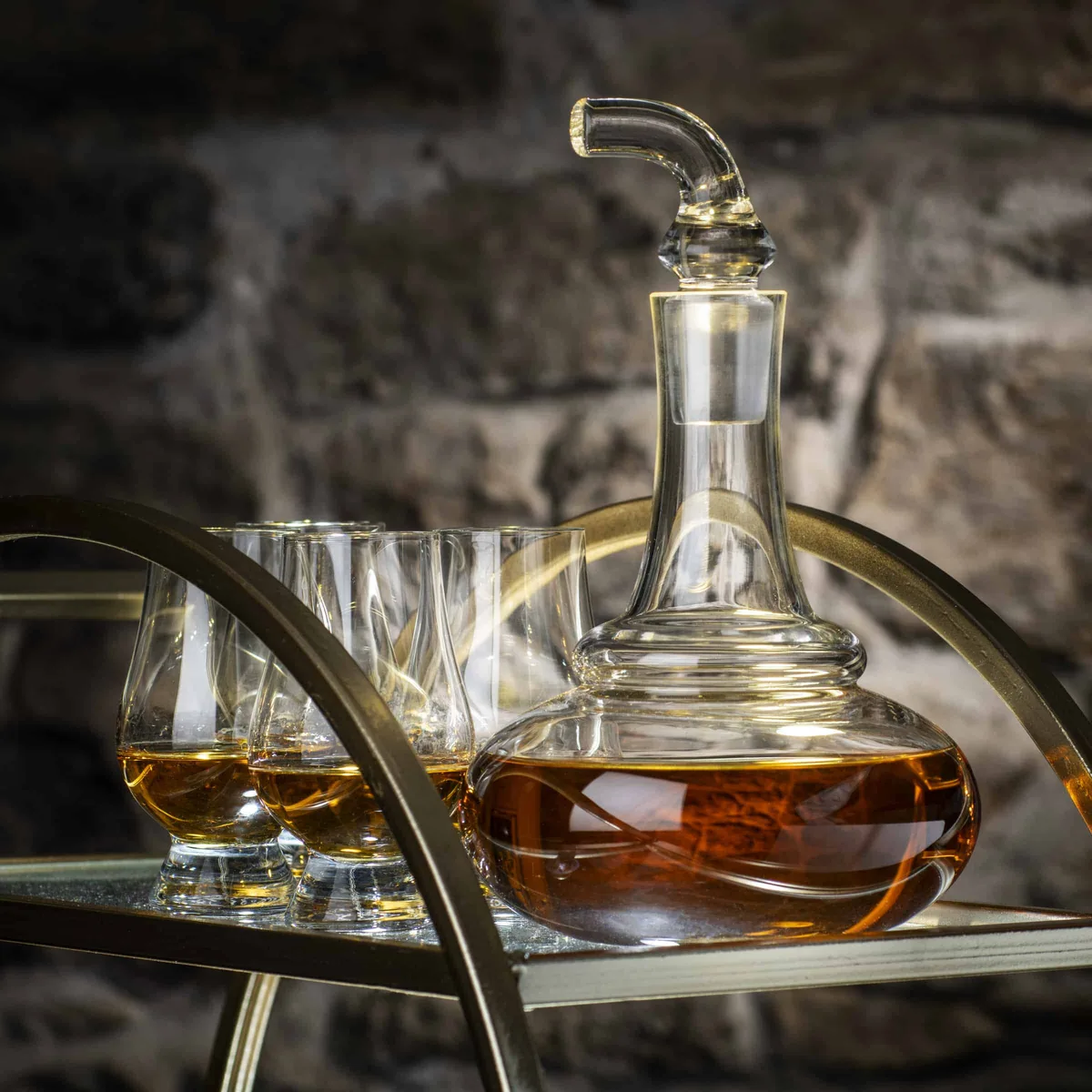
What a decanter is good at
A decanter earns its space when you are serving. You can pour without fighting a sticky metal cap. You can see the color. You can leave the original bottle in the cupboard if you do not want a label-heavy table. For a small tasting at home, a decanter plus matching glasses looks calmer than a forest of bottles, which is sometimes the point of hosting a tasting.
A stopper that actually seals is part of that job. A loose glass stopper that sits on the neck is not the same thing as a tight cork or a ground stopper that fits. If you can smell the whiskey strongly from a closed decanter across the room, it is evaporating into the room.
What a decanter is bad at
Whiskey in a half-empty bottle is already in a fight with air. Pouring it into a wide decanter with a so-so stopper usually speeds that fight up. Light, heat, and a lot of headspace are the usual enemies, and a clear decanter on a sunny sideboard offers all three. If you care about a rare or favorite bottle, leave it in its original container, upright, in a dark cupboard, as the storage guide recommends.
A decanter also forgets the label. That sounds obvious until you have two similar amber pours and no idea which is which. If you decant, use a discreet tag, a collar, or a note in a drawer. Future you will not remember.
Lead crystal is a special case. Many modern decanters are sold as lead-free crystal, which is the simpler choice for something that will hold a spirit. If you have an older leaded piece and you want to use it, do not park whiskey in it for long periods; treat it as a short serving vessel and wash it after. When in doubt, read the maker’s current guidance, and see caring for crystal.
How to fill, pour, and empty one
Wash and dry the decanter before the first use, even if it is new. Funnel slowly so you do not splash and so you leave a little room at the neck. Fill it for an occasion or a short stretch of days, not “for the year.” When the decanter is empty, wash it and put it away dry. A damp, closed decanter grows a stale smell that the next pour will pick up.
Pouring from a full decanter can be clumsy. Practice over the sink once. A neck with a spout or a well-cut lip is easier than a sharp, wide mouth. Use a tasting glass or a tumbler that you can hold steadily, and do not top up a glass you are still nosing if you are trying to taste carefully.
Cleaning the awkward interior
A narrow neck is the tax you pay for a pretty shape. Warm (not shocking-hot) water, a drop of mild unscented detergent, and a soft bottle brush will do most of the work. Rinse until the smell is gone. For a film you cannot reach, a mix of rice or crushed ice with a little water, swirled gently, can help; rinse well. Avoid abrasive powders on cut crystal, and avoid leaving a decanter to dry in a closed cabinet while it is still wet.
If a stopper sticks, do not twist with force until the neck cracks. Warm the neck slightly with a cloth and ease the stopper out. If it will not move, stop and look up a method that does not involve a hammer.
A modest rule of thumb
If you will finish the contents within a couple of weeks, and the decanter sits out of the sun, a tight stopper is usually good enough for a daily bottle. If the whiskey is something you open twice a year, leave it in the original bottle. If you do not know which kind of bottle this is, it is probably the second kind.
Label quietly. Wash promptly. Do not use a decanter as a way to hide how much is left from yourself; that is a different problem, and the honest response is to pour less, or less often, not to change the glass.
A decanter is a serving tool with a limited storage life. Use it when you want the table to look finished, keep favorite bottles in their original glass, and wash the vessel when the pour is done. That is the whole trick, and it is enough.
What a stopper actually does
A stopper is not a bottle cap. A well-fitted stopper slows evaporation and keeps dust and kitchen smells out of a short-term serving bottle. It does not create a distillery-style seal, and it will not stop a spirit from changing if the decanter sits in a sunny window for months. If the stopper rattles, or if you can smell the whiskey from a foot away with the stopper in, treat the vessel as a pourer for the evening and move leftovers back into the original bottle when you are done.
When you shop, look at the joint, not only the cut pattern. A ground or well-seated stopper you can lift cleanly is more useful than a decorative finial that sticks or leans. Our 2026 researched glassware and decanter list includes current official options so you can compare shapes without treating any of them as a storage miracle.