
This guide is for readers of legal drinking age (21 and older in the United States). It is about taking care of glassware, not about drinking more. If you do not drink, you do not need to start because of anything written here. Do not drink and drive, and do not drink during pregnancy. Alcohol is not a health product.
Crystal and good glass are tools. They chip, they cloud, and they pick up the smell of a dishwasher tablet if you treat them like everyday mugs. A little care keeps a tulip or a decanter worth using; neglect turns a gift set into a cloudy cabinet display. This is a practical care guide, not a lab test, and not a claim that every piece in a catalog is “real crystal” in the same way.
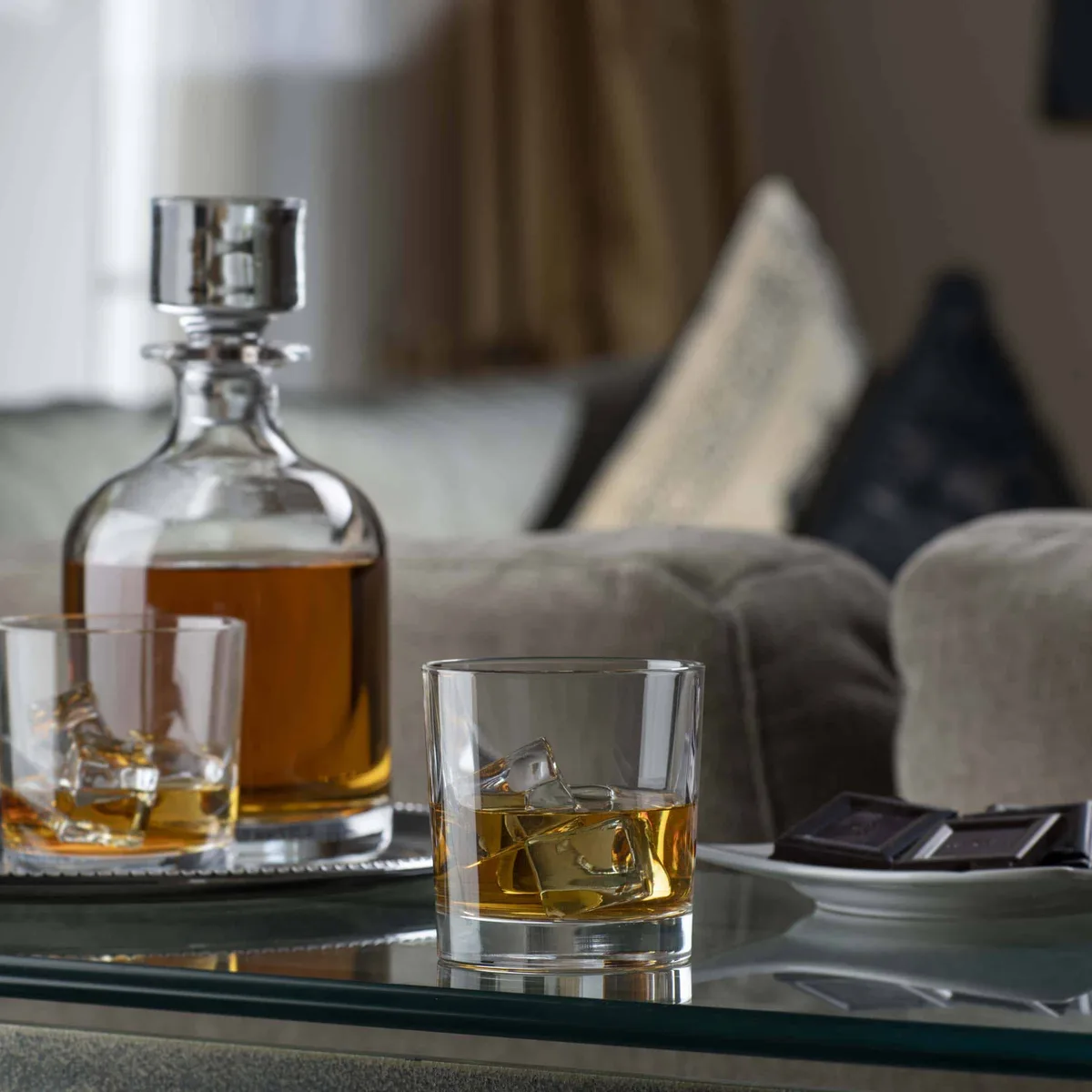
Crystal, glass, and the lead question
“Crystal” in a shop listing can mean several things: a leaded glass with a high refractive look, a lead-free crystalline glass, or ordinary glass with a decorative cut. The care is similar — wash gently, avoid shocks, store where pieces cannot knock together — but the lead question is not only about sparkle. Many modern whiskey glasses and decanters are sold as lead-free, which is the simpler choice for anything that will hold a spirit. If you have an older leaded decanter, do not use it as long-term storage. Treat it as a short serving vessel, if you use it at all, and wash it after. When the maker still publishes guidance, follow that guidance.
You do not need a chemical kit to enjoy a glass. You do need to know what you bought. A stamped “lead-free crystal” on a current official page is more useful than a family story about a cabinet piece. If you cannot tell, and the piece will hold alcohol for more than a brief pour, prefer a modern lead-free glass for daily use and keep the heirloom on display. Our decanter guide covers how long a spirit should sit in a serving vessel at all.
Washing without dulling or cracking the glass
Hand-washing is the conservative default for thin rims, cut patterns, gold or platinum bands, and anything the maker says is not dishwasher safe. Use warm water, not a blast of boiling water into a cold glass, and a drop of mild, unscented detergent. A bottle brush or a soft sponge that has not been used on greasy pans is enough. Hold the bowl in your palm and wash the stem or base with the other hand — twisting a delicate stem while the bowl is locked in a tight grip is a classic way to snap it.
Rinse until the glass smells like nothing. Detergent film will show up in the next nose as much as in the shine. Air-dry on a rack or a clean cloth, or polish with a lint-free towel once the piece is cool enough to handle. If you polish, hold the bowl and the base separately so you are not wringing a stem.
Dishwashers vary. Some modern, sturdy, lead-free glasses are listed by the maker as dishwasher safe, usually on a gentle cycle and away from other items that can knock the rim. That is the maker’s statement, not a general rule. Crowding a dishwasher with a cut-crystal tumbler next to a cast-iron pan is how chips happen. Heat, hard water, and strong detergent can leave a cloudy film that looks like damage even when the glass is intact. If you do use a dishwasher, pull pieces out before a high-heat dry, and stop using that cycle if a favorite glass comes out dull.
Cloudiness, hard water, and smells
A white film after washing is often mineral deposits, especially in hard water. A short soak in a mild, food-safe acid the maker would not object to — typically diluted white vinegar — followed by a thorough rinse, is the usual home approach. Do not mix random cleaners, and do not scour cut crystal with abrasive powder. If the cloudiness is inside the glass, like a haze that does not wipe off, it may be etching from repeated harsh detergent or very hot washes. Etching does not polish out. Retire that glass from serious nosing and use it for water, or recycle it if it is no longer safe to handle.
A musty or damp smell means the piece was stored wet or closed. Leave it open to dry completely. For a decanter, a stuck stopper should be eased, not forced; a warm cloth on the neck is gentler than twisting until the glass fails. Rice or crushed ice swirled with a little water can help a film in a narrow neck; rinse until no grit remains.
Glasses also pick up cupboard smells — cardboard, spice, a scented candle. Store them where they can breathe a little, and give a glass a rinse before a tasting if it has been sitting for months. The first thing you smell should be the pour, not the shelf.
Storage, chips, and when to stop using a glass
Store glasses upright or according to the maker’s note, with a little space between rims. Stacking thin tulips is a good way to chip the very edge you drink from. A stem rack is useful if you own stemmed copitas; a simple shelf is enough for Glencairn-style glasses and tumblers. Keep them out of a high-traffic edge where a sleeve will catch a base.
Inspect the rim with a fingertip before a tasting. A small chip can cut a lip, and it will catch and grow. A professional glass repair exists for some valuable pieces; for a ten-dollar tumbler, replacement is the usual answer. Do not grind a chip yourself over the kitchen sink unless you know what you are doing. A cracked bowl or a starred base is done — recycle it, do not pour into it.
Thermal shock is underrated. A glass stored in a cold garage, or a very heavy ice cube straight from a hard freezer, can crack a thin bowl when a room-temperature spirit hits it. Let ice and glass meet closer to the same temperature, as we note in clear ice and whiskey stones. Do not pour boiling water into a decanter to “clean it faster.”
Buying with care in mind
If you are still shopping, sturdiness is a feature. A short, solid-based tulip survives a weeknight better than a long, fragile stem, which is one reason the official Glencairn shape is popular at home. Cut patterns look festive and are harder to wash. Gold rims should stay out of the dishwasher. Matching glasses are easier to store and to replace. Our 2026 researched list describes current official glasses and decanters as researched picks, not as objects we have lab-tested for chip resistance.
Care is part of hosting, too. If you pour a small tasting at home, wash the glasses the same night, or at least rinse them. Dried whiskey is stickier than people expect. A calm tasting ends with safe rides home and a clean rack, not with a sink full of cloudy tulips in the morning. Glassware is a tool. Treat it like one, and it will stay out of the cupboard and in your hand — for the modest pours it was meant to hold.